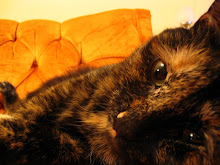
On the Phone with My Mother
Mom: Why is your cat crying like that? Is she hungry?
Me: That's not my cat, that's Patsy Cline.
*
In the Elevator with a Young Male Stranger
Me: (said matter-of-factly right as I got on the elevator) You smell nice.
Him: It's Axe.
Me: Oh... no...
*
Dad on the Phone with Sister
Dad: Oh... Where? Yeah...Good! You can see the Bell - that Bell they have... yeah, or cream cheese...
(At which point I cracked up 'cause I knew the other part of the conversation was my sister talking about a possible visit to Philadelphia.)
Showing posts with label family. Show all posts
Showing posts with label family. Show all posts
Saturday, June 13, 2009


Sunday, March 22, 2009
Low Tech Home Ec

If you liked the Mabel Hyde Kittredge blog post
from March 10th, you will love this online library from Cornell University called HEARTH! It stands for Home Economics Archive: Research, Tradition, History.
from March 10th, you will love this online library from Cornell University called HEARTH! It stands for Home Economics Archive: Research, Tradition, History.
These amazing home economics texts from 1800 to 1999 can teach your children to sew or help you discover if your cocoa contains arsenic. They might also remind you how good you have it.
(Or when it comes to adulterated food, maybe not.)
Image from The home and its management: a handbook in homemaking, with three hundred inexpensive cooking receipts by Mabel Hyde Kittredge
Tuesday, March 10, 2009
I Love What You've Done with Your Tenement Flat
I have no idea why this 1911 book, Housekeeping Notes: How to Furnish and Keep House in a Tenement Flat, is in print, but I'm so glad it is! It reminds me of my visit to the Lower East Side Tenement Museum.
It seems to be an instructional book for teachers in Housekeeping Centers who were to teach young women from the tenements (I'm assuming they were women), how to keep house. It lists what one needs to set up a home in a tenement, how much it would cost, and how to maintain everything. It is also full of things to be grateful for (i.e. that I don't need to keep coal for a stove, etc). It also defaults to a family of five, and addresses both units with or without shared bathrooms.

I like the frank approach the book takes:

After the first Tenement House Act, landlords tried to get legislation passed to undermine it. Check out this New York Times article from 1896. (Viewing the full article is free.)
There are probably lots of current books regarding public policy on low-income housing, and plenty of material on organizing social activism, but I can't imagine anyone publishing something like this now. It would be like publishing "Your Home in the Projects: How to Keep It Clean and Gorgeous". There are plenty of websites to tell you how to live frugally, or make furniture from Fed-Ex boxes, but I'm not sure if it's quite in the same spirit.
These types of courses were what eventually became public school Home Economics courses (I think). They were gone by the time I got to junior high. Unfortunately, I really needed this kind of training - I'm a pretty lousy housekeeper! I wish Home Ec and Auto Mechanics had been mandatory. However, with tuberculosis and bedbugs on the rise in T.O., perhaps we may as well look to 1911 for help.
Photos of 97 Orchard Street, Lower East Side, NY, from Tenement.org
It seems to be an instructional book for teachers in Housekeeping Centers who were to teach young women from the tenements (I'm assuming they were women), how to keep house. It lists what one needs to set up a home in a tenement, how much it would cost, and how to maintain everything. It is also full of things to be grateful for (i.e. that I don't need to keep coal for a stove, etc). It also defaults to a family of five, and addresses both units with or without shared bathrooms.

I like the frank approach the book takes:
Shelves for china in the dining-room are better than a sideboard, the latter being too large for an ordinary tenement room. Cheap sideboards are also very ugly.These courses dealt with the reality of living in the tenements. Tenements were notoriously crowded, poorly maintained, and were built with the absolute minimum regard for human comfort and safety. They were such unhygienic fire-traps that they essentially spurred lawmakers to create building code laws. Tenement landlords were eventually forced by law to upgrade all their buildings to have indoor plumbing, and they argued at the time that it was too costly and not worthwhile.
Book shelves are a necessity in the living-room…

After the first Tenement House Act, landlords tried to get legislation passed to undermine it. Check out this New York Times article from 1896. (Viewing the full article is free.)
There are probably lots of current books regarding public policy on low-income housing, and plenty of material on organizing social activism, but I can't imagine anyone publishing something like this now. It would be like publishing "Your Home in the Projects: How to Keep It Clean and Gorgeous". There are plenty of websites to tell you how to live frugally, or make furniture from Fed-Ex boxes, but I'm not sure if it's quite in the same spirit.
These types of courses were what eventually became public school Home Economics courses (I think). They were gone by the time I got to junior high. Unfortunately, I really needed this kind of training - I'm a pretty lousy housekeeper! I wish Home Ec and Auto Mechanics had been mandatory. However, with tuberculosis and bedbugs on the rise in T.O., perhaps we may as well look to 1911 for help.
Photos of 97 Orchard Street, Lower East Side, NY, from Tenement.org
Monday, December 22, 2008
Chanuka - Delicious Any Way You Spell It

First night of Chanuka, and as my parental units did not want to worry about me driving in the GTA's current weather, I stayed home. We said the blessing over the lighting of the candles together over the phone. I also made lazy daisy latkes-from-a-box. (See little photo above?) Delicious!
As for explaining Chanuka, I'll let my copy of Jewish Literacy by Rabbi Joseph Telushkin take it away:
In 167 B.C.E., the Syrian emperor Antiochus set out to destroy Judaism by making its observance a capital offense... A Jew named Mattathias, along with his five sons, initiated a revolt against the Syrian monarch. Three years later, the rebels ousted Antiochus's troops from Palestine.
The Jewish revolutionaries, known as Maccabees or Hasmoneans, regained control of the Temple in Jerusalem, which during the years of Syrian control had been spiritually raped. Antiochus had even arranged for swine to be sacrificed in the Temple. The Jewish troops wept when the saw the Temple's degradation, and immediately resolved to restore it to a state of ritual purity. According to Jewish tradition, they could find only one cruse of uncontaminated olive oil; unfortunately, it contained oil sufficient for only one day. The Jews were very upset because it would take eight days to prepare ritually permitted oil. However, a miracle happened and the small quantity of oil continued to burn the full eight days.
Now we celebrate with fried foods, specifically latkes and soufganiot. Although, if you wanted to add churros and veggie dumplings and rosti to your tradition, I'd be the last to criticize.
Here's my gathering of Chanuka recipes. An unofficial carnival of sorts (since I can't find an actual Chanuka blog carnival to direct you to):
Food Touring from Austin shares Sweet Potato Curry Latkes
Marcy Goldman makes her own version of lazy daisy latkes using a mix & potatoes.
Bureka Boy didn't make latkes, he made Sephardi fritters called Bimuelos. I'm Sephardi and while I'm pretty sure I've eaten those, I've never heard them called bimuelos. Then again, my parents speak Judeo-Arabic, not Ladino. (And as a bonus, his preceding post has a madeleine recipe, which I've been looking for.)
Epicurious taps chef Paul Virant for a simple but good-lookin' latke recipe. The comments on that post are sweet too.
Happy Holidays! Eat! Eat!
Saturday, November 08, 2008
More Childhood Books: Encyclopedia Brown
I loved Encyclopedia Brown growing up.
He was a good kid. Smarter than the grown-ups, unafraid of bullies, and his best friend was a girl. Actually, I forgot that his best friend was a girl till I re-read one of the books last night. The mysteries hold up well (and I even remembered some of the solutions - not solved, but remembered from when I was nine or twelveor whatever). The dialogue is a little dated, but that's a positive rather than a negative. The metaphors are funny; the sarcasm child-like and not obnoxious.
This part shocked me however:
Philip Pullman has said that it's easiest to write a kid's story with an orphan as the protagonist, because parents just get in the way. I think he's right, and it's something that most writers intuit quite quickly (unless the parents are part of the story, or must be there to provide a safe haven for the end). When a child is the hero of the story, parents are usually absent (negligent/deceased/ill/in a parallel world):
I guess I'm so familiar with a children's lit character having no parents, that I found Encyclopedia's respect for grown-ups incredibly sweet and startling.
The Encyclopedia Brown books are written by Donald J. Sobol and have been in print since the late '60s.
Addendum: How did I forget Oliver Twist?!
He was a good kid. Smarter than the grown-ups, unafraid of bullies, and his best friend was a girl. Actually, I forgot that his best friend was a girl till I re-read one of the books last night. The mysteries hold up well (and I even remembered some of the solutions - not solved, but remembered from when I was nine or twelveor whatever). The dialogue is a little dated, but that's a positive rather than a negative. The metaphors are funny; the sarcasm child-like and not obnoxious.
This part shocked me however:
On Tuesday, business was slow all morning till Elmo Thomas came in.Sure, as children, we often feel our parents' decisions are unfair, but Encyclopedia's defence of parents and grown-ups in general is so rare, that it made me pause and re-read the dialogue - and notice how mild Elmo's complaint is. (Compare it to the way child 'sass' has been depicted in books, tv shows, and film since the 80s).
"Mothers," he grumbled. "They don't understand kids."
"That's no way to talk," protested Encyclopedia.
Philip Pullman has said that it's easiest to write a kid's story with an orphan as the protagonist, because parents just get in the way. I think he's right, and it's something that most writers intuit quite quickly (unless the parents are part of the story, or must be there to provide a safe haven for the end). When a child is the hero of the story, parents are usually absent (negligent/deceased/ill/in a parallel world):
- Sarah in "A Little Princess" - orphan
- Mary in "The Secret Garden" - orphan
- Lyra in "The Golden Compass" - orphan in the sense that her parents are not her guardians nor are they known to her
- Will in "The Subtle Knife" - only child to an ill single mother and long-lost father - in modern child psychology, Will would be considered "parentified"
- Huckleberry Finn - under guardianship of Widow Douglas and then later escaping a neglectful alcoholic father
- Harry Potter - perhaps the most famous children's lit orphan of our time
- Pippi Longstockings - living alone with her horse and her monkey; father lost at sea
I guess I'm so familiar with a children's lit character having no parents, that I found Encyclopedia's respect for grown-ups incredibly sweet and startling.
The Encyclopedia Brown books are written by Donald J. Sobol and have been in print since the late '60s.
Addendum: How did I forget Oliver Twist?!
Thursday, October 02, 2008
Hairy, Puttering, and the Ordering of the Pizza
Certain members of my family have been eyeing my career (or lack thereof) with fear and pity since I embarked on this whole "Gee Whiz, I'm a Writerer!" thing.
The only thing that has changed is the question I get at family gatherings:
"You know that writers don't make any money, right?" became "So, are you going to be J.K. Rowling*?"
From the poorhouse to the penthouse with nary a word published!
In tribute to them, here is New York Mag's summary of Forbes' list of wealthiest authors. See that? Authors. It's plural!
*check out her official site, it's insane.
The only thing that has changed is the question I get at family gatherings:
"You know that writers don't make any money, right?" became "So, are you going to be J.K. Rowling*?"
From the poorhouse to the penthouse with nary a word published!
In tribute to them, here is New York Mag's summary of Forbes' list of wealthiest authors. See that? Authors. It's plural!
*check out her official site, it's insane.
Monday, September 29, 2008
Honey Honey Cake Cake

It is 1:40am as I write, so I'll make this short and SWEET. I'll let you google all other Rosh Hashana info yourself. This blog post is hereby devoted to honey cake recipes:
Marcy Goldman's Moist and Majestic Honey Cake - the one I will probably get around to making with buckwheat honey - Smitten Kitchen bakes it here
Cookthink's recipe from 2007. She misses her grandma, I miss my aunt. Sigh.
Eat the Blog - adapted from a Ruth Sirkis recipe
Baroness Tapuzina's honey cake as adapted from The New Israeli Food cookbook
Bureka Boy posts two versions of honey cake and both look delicious
Adorable Honey Cake - made with honey wine! and Chocolate Fig Honey Cake (drool) both from the Food Network
One Honey of a Cake - from the Parve Baker
Bella's Honey Cake - with raisins and walnuts from Homemakers magazine (remember them?)
Lastly, a Honey Bundt cake from Recipezaar and here's a Magen David-shaped bundt pan to bake it in.
Shana Tova v'Metukah!
(If you're wondering about my free clip-art trend, it's 'cause my camera display is broken... but you can print up the clip-art and color it in! Free activities!)
Sunday, February 10, 2008
Violins and Orchids
I have just been introduced to Samuel Barber's Op.14 Concerto for Violin. I want to own it. I go to iTunes. I browse around and decide on an album I like. It is this one. ITunes sells it for $9.99 CAD.
Then I pause and wonder if I shouldn't support my local classical music store. It's been there forever and I rarely buy anything there. I would be sad if it closed down. There it costs $15.98 CAD.
Then I think, is it fair to ask me to pay six more dollars because it's an actual CD that comes in a case? Or am I just paying for their rent in Yorkville? (But then, I'd be sad if they moved.)
Then I look a little further - just to find a good link to the album for this blog and find an even cheaper option. Sony-BMG sells the album for $7.95 USD (which at this time is still $7.95 CAD). Sony is the distributor of the RCA Victor Red Seal line. So, pass the middle men?
What to do? Which option benefits the artist? Which option benefits the environment? Which benefits my local economy?
I'm still undecided. Maybe I'll just request it from the local classical station and save myself the headache of trying to be conscientious.
*
Today was my parents' 48th wedding anniversary. That means my sister and I have two years to plan their 50th! (G-d willing, right?) Anyhow, I took them to the Southern Ontario Orchid Society Show at the Toronto Botanical Gardens. It was a judged show with hundreds of stunning orchid specimens on display. Eventually I'll post some photos. Then we went to LCBO 'cause my parents like to browse the wines, the beers, the everythings. They're not big drinkers, but they appreciate an occasional whistle-whetting. (Me too...) Finally we headed to the parental units house for bruschetta and champagne and then I left them alone.
Now someone on my floor is cooking something with fried onions and I'm ready to eat again...
Then I pause and wonder if I shouldn't support my local classical music store. It's been there forever and I rarely buy anything there. I would be sad if it closed down. There it costs $15.98 CAD.
Then I think, is it fair to ask me to pay six more dollars because it's an actual CD that comes in a case? Or am I just paying for their rent in Yorkville? (But then, I'd be sad if they moved.)
Then I look a little further - just to find a good link to the album for this blog and find an even cheaper option. Sony-BMG sells the album for $7.95 USD (which at this time is still $7.95 CAD). Sony is the distributor of the RCA Victor Red Seal line. So, pass the middle men?
What to do? Which option benefits the artist? Which option benefits the environment? Which benefits my local economy?
I'm still undecided. Maybe I'll just request it from the local classical station and save myself the headache of trying to be conscientious.
*
Today was my parents' 48th wedding anniversary. That means my sister and I have two years to plan their 50th! (G-d willing, right?) Anyhow, I took them to the Southern Ontario Orchid Society Show at the Toronto Botanical Gardens. It was a judged show with hundreds of stunning orchid specimens on display. Eventually I'll post some photos. Then we went to LCBO 'cause my parents like to browse the wines, the beers, the everythings. They're not big drinkers, but they appreciate an occasional whistle-whetting. (Me too...) Finally we headed to the parental units house for bruschetta and champagne and then I left them alone.
Now someone on my floor is cooking something with fried onions and I'm ready to eat again...
Subscribe to:
Posts (Atom)